
If you are seriously considering Sindh police jobs in Pakistan in 2026, this is more than just another vacancy update. It is a long-term career decision that can shape your professional life, financial stability, and social standing for decades.
Sindh Police recruitment in 2026 is expected to follow a structured, merit-driven system, with thousands of applicants competing for limited positions across constabulary, investigation, traffic, and specialist branches. Therefore, understanding how recruitment truly works is more important than simply knowing the deadline.
This expert guide explains eligibility, salary structure, promotion pathways, selection realities, and how to apply correctly — based on actual public sector recruitment patterns in Pakistan.
Understanding the Role of Sindh Police in Pakistan
Sindh Police operates under the Government of Sindh and is responsible for maintaining law and order across urban and rural districts including Karachi, Hyderabad, Sukkur, and interior Sindh.
In 2026, the department continues to expand in response to:
- Urban population growth
- Increased security demands
- Counter-terrorism responsibilities
- Traffic regulation challenges
- Digital crime investigations
Unlike private jobs, police service combines enforcement authority with public accountability. This makes it both prestigious and demanding.
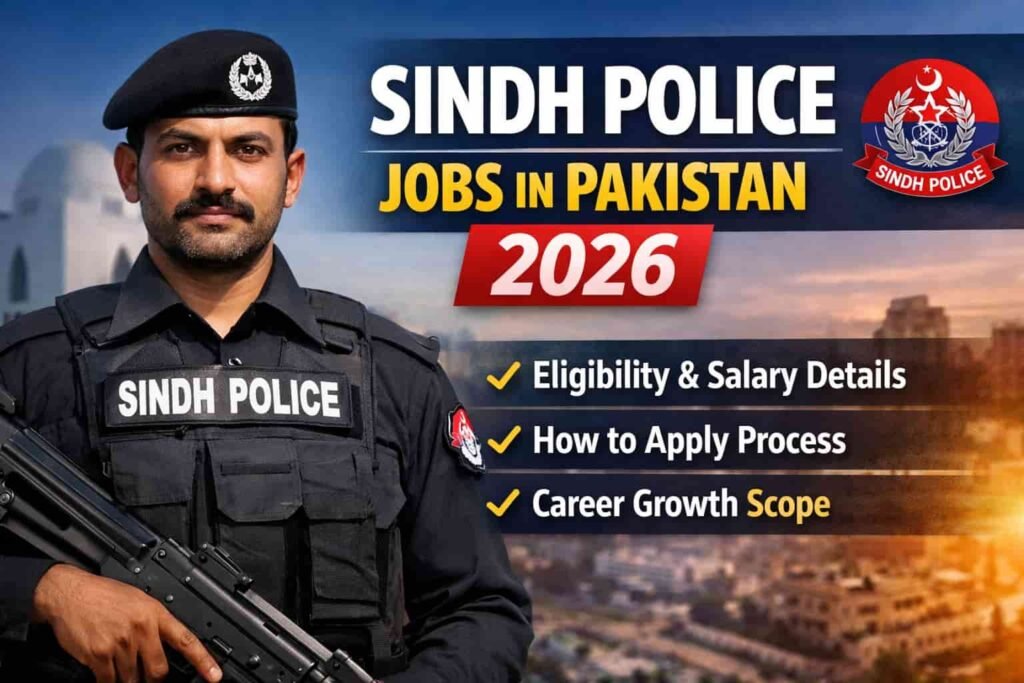
Sindh Police Jobs in Pakistan in 2026 – What Positions Are Expected?
Recruitment cycles typically open for the following categories:
1. Constable (BPS-07)
- Most common entry-level role
- Field duties
- Patrol, checkpoint, investigation support
2. Lady Constable
- Women-specific recruitment drive
- Increasing demand in 2026 due to gender inclusion policies
3. Driver Police Constable
- Requires LTV/HTV license
- Often fewer applicants but strict verification
4. Assistant Sub Inspector (ASI) – BPS-11
- Investigation-level responsibilities
- Higher competition
5. Specialist & Technical Roles
- IT support
- Forensic assistance
- Wireless operator
- Legal clerks
Each position has distinct qualification, physical, and written requirements.
Who Should Apply for Sindh Police Jobs in Pakistan in 2026?
This career suits candidates who:
- Prefer government service stability
- Can handle physical and psychological pressure
- Are comfortable with shift duties
- Value uniformed authority and public interaction
- Seek long-term pension benefits
However, it may not suit individuals looking for fixed office hours or low-stress desk jobs.
Eligibility Criteria Explained with Context
Eligibility is not just a checklist; it reflects operational demands.
Educational Qualification
- Constable: Matric minimum
- ASI: Intermediate or higher
Higher education often improves merit position but does not change basic BPS scale.
Age Limit
- Usually 18–28 years
- Age relaxation may apply under Sindh government policy
Physical Standards (Male)
- Height: 5’5” minimum
- Chest: 33” with 1.5” expansion
Physical Standards (Female)
- Height: 5’0” minimum
Domicile Requirement
- Sindh domicile mandatory
- District-based quota strictly enforced
In recent cycles, incomplete domicile documentation has been one of the top rejection reasons.
Salary Structure and Financial Reality in 2026
Many candidates search for:
- Sindh Police jobs 2026 salary
- Police constable pay scale in Sindh
- ASI salary in Pakistan 2026
Here is a realistic breakdown.
Estimated Monthly Salary Structure (2026 Projection)
| Position | Basic Pay Scale | Estimated Gross Salary | Key Allowances | Promotion Potential |
|---|---|---|---|---|
| Constable | BPS-07 | PKR 42,000–50,000 | Risk allowance, medical, house rent | Head Constable |
| Lady Constable | BPS-07 | PKR 42,000–50,000 | Same as above | Same ladder |
| ASI | BPS-11 | PKR 55,000–70,000 | Investigation allowance | SI promotion |
| Driver Constable | BPS-07 | PKR 45,000–52,000 | Driving allowance | Technical track |
Long-Term Financial Benefits
- Annual increments
- Pension after retirement
- Government medical facilities
- Job security during economic downturn
In 2026’s uncertain private sector market, this stability is a major attraction.
Career Growth & Promotion Path
Promotion in Sindh Police is both time-bound and performance-based.
Typical career ladder:
Constable → Head Constable → ASI → Sub Inspector → Inspector
Internal departmental exams play a crucial role. Candidates who continue education during service often advance faster.
From experience, officers who maintain clean disciplinary records and pass promotional exams on first attempt move up significantly quicker.
Real Recruitment Pattern Observed in Previous Cycles
From past recruitment trends:
- Physical test eliminates 40–50% candidates
- Written test filters another 30–40%
- Document discrepancies cause unexpected disqualifications
- Fake certificates lead to permanent blacklisting
Merit lists are district-based. Therefore, competition varies depending on district applicant ratio.
Karachi divisions typically see higher competition than interior Sindh districts.
Step-by-Step Application Process for Sindh Police Jobs in Pakistan in 2026
Here is the realistic journey applicants should expect:
Step 1: Official Advertisement Review
Check official advertisement through Sindh Police website or Government of Sindh portal.
Step 2: Download Application Form
Available through official recruitment portal.
Step 3: Prepare Required Documents
- CNIC copy
- Domicile & PRC
- Educational certificates
- Passport-size photographs
- Driving license (if applicable)
Step 4: Online Registration (if applicable)
Fill digital form carefully. Avoid spelling mismatches with CNIC.
Step 5: Fee Submission
Usually via bank challan in designated banks.
Step 6: Physical Test Call
Bring original documents.
Step 7: Written Examination
Basic English, General Knowledge, Pakistan Studies, Islamic Studies.
Step 8: Interview & Medical Examination
Final verification stage.
Step 9: Final Merit List
Published district-wise.
Always retain application slip and fee receipt. Missing challan proof has disqualified candidates in previous years.
Common Reasons Applicants Fail
- Incorrect domicile documentation
- Height measurement below standard
- Incomplete application form
- Late submission
- Weak preparation for written test
- Ignoring physical fitness training
Preparation must start at least 6–8 weeks before physical test.
Apply here ; https://www.sindhpolice.gov.pk/
Also apply here ; https://paksjobs.com/matric-pass-jobs-in-pakistan-in-2026/
Skills That Improve Selection Chances
- Basic English comprehension
- Running stamina (1.6 km practice)
- Discipline & confidence
- Clean background record
- Digital form accuracy
In 2026 recruitment systems are increasingly digitized, reducing manual interference.
Frequently Asked Questions (FAQs)
What is the eligibility for Sindh police jobs in Pakistan in 2026?
Matric for Constable and Intermediate for ASI, with Sindh domicile and required physical standards.
What is the salary for Sindh police jobs in Pakistan in 2026?
Constables earn approximately PKR 42,000–50,000 monthly including allowances.
How to apply for Sindh police jobs in Pakistan in 2026?
Apply through official Sindh Police recruitment portal, submit documents, pay challan, and appear for tests.
Is there age relaxation in Sindh police jobs in Pakistan in 2026?
Age relaxation depends on Government of Sindh policy and category.
Are Sindh police jobs in Pakistan in 2026 permanent?
Yes, selected candidates are appointed on permanent government scale with pension benefits.
Final Career Advice for 2026 Applicants
Sindh police jobs in Pakistan in 2026 are not just employment opportunities — they are structured public service careers with authority, stability, and long-term benefits.
However, competition is serious. Candidates who prepare early, maintain physical standards, and complete documentation correctly significantly improve their chances.
If you seek:
- Government job security
- Social respect
- Steady financial growth
- Long-term pension structure
Then Sindh Police can be a strong career choice in 2026.
Make your decision carefully. Prepare strategically. Apply professionally. And approach the process with discipline — because in uniformed service, discipline begins before selection.